Showing posts with label Geek Day. Show all posts
Showing posts with label Geek Day. Show all posts
02 February 2012
Wednesday Movie - Its all a question of perspective
Something a bit different this week - some cool Dutch dudes doing some wacky street painting

16 November 2011
Global warming
Very nice video here that demonstrates mean surfaces temp across the Earth for the past 250 years
And there are still people who think the planet is warming...
Mind you most of them are in the GOP or Tory parties
And there are still people who think the planet is warming...
Mind you most of them are in the GOP or Tory parties
07 June 2011
Best and worst of the USA
Got married at the weekend!
Lots to follow on that but in the meantime I found some great maps on Strangemaps that show the best and worst of each US state. Classic. I love the fact that the Utah has the highest reported well being and the most porn usage - you gotta love those Mormons...


Lots to follow on that but in the meantime I found some great maps on Strangemaps that show the best and worst of each US state. Classic. I love the fact that the Utah has the highest reported well being and the most porn usage - you gotta love those Mormons...


14 April 2011
Geek Day - the international space station
Terry sent me this link which shows how the international space station has been assembled over the past twenty years. It is very cool but it does also resemble trailer park with various pieces of junk being parked next to a load of old caravans.
"Hey Joe, stick that camper van in the space between the tractor with one axel and the burnt out minibus"
"Hey Joe, stick that camper van in the space between the tractor with one axel and the burnt out minibus"
17 March 2011
Improbable Research - Kansas
The middle of the US is often quoted as being "as flat as a pancake". Such statements are typically subjective but you can always rely on some anal scientist to come along and test such hyperbole.
So in a peer reviewed article Fonstad et al (2003) tested that hypothesis and concluded that Kansas was indeed flatter than a pancake.
They didn't manage to explain why Kansas was so dull
So in a peer reviewed article Fonstad et al (2003) tested that hypothesis and concluded that Kansas was indeed flatter than a pancake.
They didn't manage to explain why Kansas was so dull
14 March 2011
Europe explained
The concept of Europe is not as simple as it might be. Travelling from Holland to Norway I leave the EU but stay in Schengen, while travelling from Holland to the UK I leave Schengen but stay within the EU. And that's the simple bit!
Fortunatly I found this on wikipedia which I thought was rather interesting...

And in case you can't remember all those flags...

24 February 2011
The Solar System
Before the internet, if you wanted to understand the relative motions of the various celestial bodies in the solar system you would have used an astrolabe. A fiendishly clever but also complicated mechanical device that modelled the potistion of the various bodies at different times. They were very difficult to use.
Now its all a whole lot easier with the advent of flash tools such as this one here.

The detail is fantatsic, if you watch the Earth (third rock from the Sun) carefully you can actually see the six month polar night/day caused of the Earth's tilt.
And just in case, like me you can't remember the order of the planets, here is a nice image from Wikipedia to help.

Now its all a whole lot easier with the advent of flash tools such as this one here.
(Click on the image or the link above to see it working)
The detail is fantatsic, if you watch the Earth (third rock from the Sun) carefully you can actually see the six month polar night/day caused of the Earth's tilt.
And just in case, like me you can't remember the order of the planets, here is a nice image from Wikipedia to help.

01 February 2011
Image resizing
If the image you want to put in a document or webpage doesn't fit, what can you do?
You can:
1. Shrink the whole thing, which means that the bit you are interested in may get too smallYou can:
2. Crop it, so that you lose context of the subject
3. Squeeze or stretch it, so that it become distorted
And until very recently that was it. There were no other options.
What else could you possibly do?
Check out this short video, its one of the coolest things I have seen in ages. I guarantee you will watch it a second time.
Stolen from Ola's blog
Stolen from Ola's blog
09 January 2011
Top-down fire
So you think you know how to light a fire - think again.
John T introduced me to the concept of the "top-down" or "upside" fire. I was a bit sceptical but after listening to his explanation and then watching a few youtube videos I decided to try it out.
The Theory
In a normal fire we start at the base with a ball of paper, then place kindling and finally, logs on top. The principal here is that since the heat and the flames rise, then they will ignite the overlying material. More stuff is then added to the top.
In a top-down fire the logs are placed on the bottom, packed as tightly together as possible. The kindling is put on top of the logs and the newspaper on top of the kindling. In this case the fire burns slowly downward. Proponents of this method suggest that it is more efficient, produces more heat, burns better, produces less smoke and takes less work. The only problem is that it is totally contrary to everything you have ever been taught about lighting fires.
The Practice
I packed the logs into the stove, getting them as tightly together as I could. Then I piled about 10 pieces of kindling on top. I was fairly sure that simple balls of newspaper would not burn long enough to ignite the kindling so I rolled a couple of sheets of paper into long thin sausages and then tied them in a knot. The idea was that these would burn far longer than a simple ball. I made 4 of them. I then put a ball of paper on top to light the rolls.
I lit the ball and this indeed got hot enough to light the rolls. After about 3 mins the kindling took and after another 7 the logs started to burn. I was surprised at how well it worked. The fire lasted for about 2 hours with no attention. There was lots of heat and virtually no ash. I left the door of the stove open as I wanted to watch and there was no smoke at all.

This was a complete success. I am a total convert.
Why does it work?
The theory is that in a "normal" fire, the kindling heats the logs above, this drives off any steam and also some of the volatiles. The steam and volatiles form the smoke. The smoke is lost energy as it is not burning or providing any heat.
In the "top-down" fire a limited amount of heat goes down, any volatiles that are generated from heating the unburnt wood are ignited as they rise into the fire. This means that the wood burns in a much more efficient manner, producing lots of heat and very little smoke.
Some videos
This guy does a controlled experiment where burns a similar amount of wood as a top-down and a tee-pee fire. Its good to see a controlled experiment and he gets the right result however, he did not pack the logs together tight enough. It would have worked better if he had not left the gaps between them. Also the vid is in three parts and most of it is a bloke in camo chopping wood with a large knife. Go straight to part three.
09 December 2010
Geek Day is back
In the Hitchhikers Guide to the Galaxy, Zaphod was put into the Total Perspective Vortex which is the most horrible torture device ever invented.
"When you are put into the Vortex you are given just one momentary glimpse of the entire unimaginable infinity of creation, and somewhere in it a tiny little microscopic dot which says "you are here"
The shear crushing realisation of your own insignificance is supposed to drive you mad (unless you are Zaphod, in which case you discover you are the centre of the Universe)
This website has a similiar goal, to show you the scale of the Universe, its pretty cool. Although I have not gone mad so maybe the universe was made for me...
28 October 2010
Accretionary Wedge #28
Accretionary Wedge #28 at Research at a snails pace is a about desk crops and since it is October there is supposed to be a scary theme.

The four bivalves in this picture were collected on a beach in the Gulf Coast of Florida in 2005. I am a sedimentologist but had taken time out from the Mesozoic to study some modern systems, particularly modern beach ridges for a project that was coincidently just published in last months Journal of the Geological Society of London.
The four bivalves in this picture were collected on a beach in the Gulf Coast of Florida in 2005. I am a sedimentologist but had taken time out from the Mesozoic to study some modern systems, particularly modern beach ridges for a project that was coincidently just published in last months Journal of the Geological Society of London.
I have always believed that sedimentology is easy because if you are struggling to understand the rocks, then all you have to do is go and look at the modern and the answer is there for you. So when the seismic data from the North Sea was ambiguous it seemed obvious that we should take a trip to Florida. There are definitely worse ways to spend your field grant than travelling around the beaches of the SE USA.
So I collected these bivales, not for any scientific reason but simply because they looked nice. They now live on a shelf in my bathroom (does that count as a desk crop?). I am not a palaeontologist and famously "don't do dead things" but I think these are "marsh clams". If somebody wants to correct me and tell me the proper species name, I would be very happy to hear.
So what is scary about the picture? At first glance it seems to be 4 bivalves arranged in order of size. But if you look more closely you will see that in addition to getting larger towards the right, they also get more haggered. The small left hand one is pure white and pristine. A perfect body that radiates a combination of innocence and optimism - the world is his oyster (or marsh clam). Moving toward the right the amount of discolouration increases as does the amount of worm borings, until the one on the right looks like it has definitly had a hard life! He is big and tough, stained and scared by his environment, like a middle aged boxer. It is an insight into what the others have to look forward to.
But then we must remember that they are all in fact dead. The left hand one will never get to grow old. It's youthful beauty preserved by an early death.
The more you think about it, the more disturbing it all becomes.
21 October 2010
If the American states were countries
The USA is an aglomeration of states which have fairly distinct cultures and indentities. If they were broken up into countries how would they fare?
One way to look at this is to consider their GDP, which has been done in this map where the individual states are replaced by countries with similiar GDP.

One way to look at this is to consider their GDP, which has been done in this map where the individual states are replaced by countries with similiar GDP.
California is the largest (similiar to France, #8 in the World)
Wyoming is the poorest and compares to Uzbekistan (#101 in the World)
My adopted home of Norway is the same as #28 Minnesota
The UK is #7 in the World and marginally bigger than California
Interestingly the GDP of the whole of Europe is almost idenitical to the USA ($13.7 vs $13.2 billion).
The map is from the excellent StrangeMaps and can be found here.
29 September 2010
Podcasts
I am a geek in that I have a strong interest in science and technology (amongst other things). I am proud of the achievements of science and I thing science should be promoted and encouraged, especially amongst young people but also across the population in general.
Living in a country where the radio and TV are in a language I don't speak very well has forced me to seek other forms of mental stimulation for my drive to work and while sitting at home. I recently discovered podcasts which are a great way of getting something worth listening to onto your ipod/iphone.
If you are interested in science I suggest Radiolab, its a totally awesome science show. They have this unique style which takes a little getting used to, but when you do you will be hooked. Gareth first pointed me towards it and I was a bit sceptical at first. Now I love it. They do 1 hour podcasts of their regular radio shop and also special "shorts" which last about 15 mins and are perfect for my drive to work. I really can't recommend this show enough. I love it. Check out http://www.radiolab.%20orgb/ or go to itunes and seach on radiolab and download and enjoy.
Science weekly from the Guardian - another very good science show, worth listening to
If you want some history, A History of the World in a Hundred Objects is a great series of podcast shorts about history told though objects by the director of the British Mueseum. Again a perfect length for my drive to work and highly educational.
Finally if you want some politcis and current affairs the Young Turks offers an educated, informed and opinionated liberal view on American Politics. It is a fantatsic antidote to the idiots like Rush Limbaugh
To download a podcast, simply go to the very shit piece of software that is iTunes and search for your chosen cast. All the ones above are free so when you find them, follow the instructions download, listen and enjoy
23 September 2010
Geek Day - more analemma
A while ago I wrote a post about a guy who had photographed the Sun every ten days for a year. The subsequent pattern reflects the various movements of the Earth. This is called the analemma and is described here on wikipedia. Despite that explanation I was still having trouble picturing how all this stuff was moving.
The other day I was playing around on this site, which allows you to look at a map of the sky from anywhere on Earth at anytime (it is made by the same guy who did the Space Invaders game) and it occured to me that I could re-create the analemma. So I set my location to 60N/5E, which is pretty much at the Lair, then filmed a day by day movie for a year from equinox to equinox. The movie is here.
You can recreate this and try putting in different latitudes and see how it impacts the suns pattern. Its pretty cool.
(Now we just have to see how many perv hits I get on a site called karmasotra with a post called anal emma...)
16 September 2010
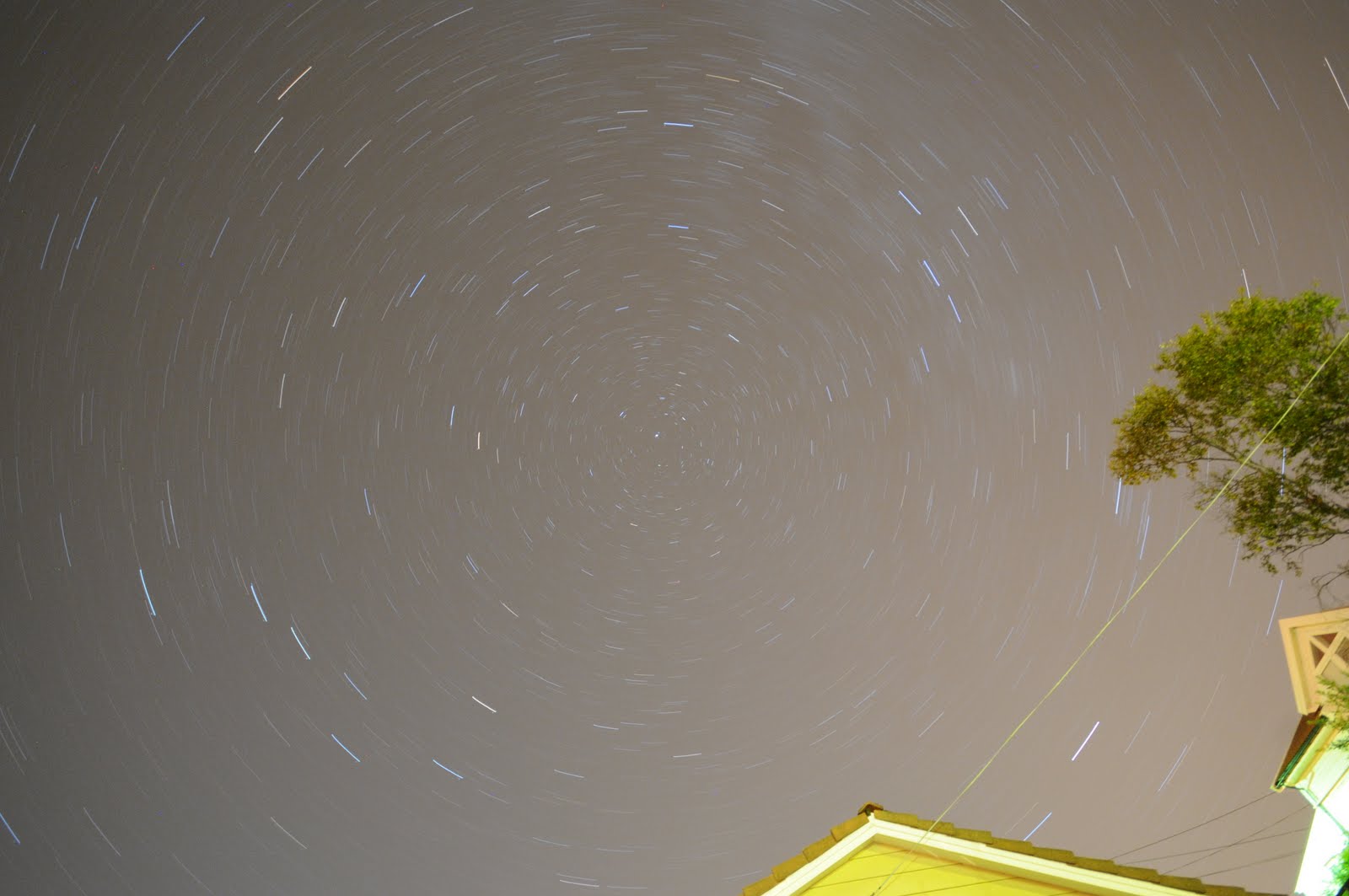
Star trails
Was inspired by a post on OlA's blog with a cool pic and an awesome video, to go out and try some star trails.
Long exposure that captures the movement of the Earth by smearing out the stars
The initial results were OK for a first attempt
Both of these were taken at the lair with a 25 minute exposure.


Long exposure that captures the movement of the Earth by smearing out the stars
The initial results were OK for a first attempt
Both of these were taken at the lair with a 25 minute exposure.

02 September 2010
Geek Day - Retro Games
I have never been a very big fan of computer games, I prefer doing stuff in the real world. However, I did feel a huge rush of nostalgia when I discovered this site where a very clever man, with obviously too much time on his hands, has re-created a series of very early computer games in flash, including space invaders, astroids and snakes.

Click here to waste hours playing and I would be interested to know if you think it has got easier since you played it as a kid
To prove that he has too much time on his hands he has also created his own a multi-res viewer for satalite images across the Earth. Smart arse! That can be found here18 August 2010
Geek Day
The picture below was taken using a home made pin hole camera over a six month period. The view is the Clifton suspension bridge in SW England. The camera was made by putting a single piece of photographic paper in a coke can with .25mm hole, taped to a telegraph pole. The lines are the tracks of the sun from the winter solstice to the summer solstice.

The original is from here where there is lots more.
11 August 2010
Geek Day - Northern Lights
One of the great things about living in high latitudes is the chance to watch the Aurora (Northern lights). The classic shimmering curtains of light are caused by the ionization of particles in the Earth's upper atmosphere by solar winds. In high latitudes (c. 70 degrees) activity is going on most of the time and all you need is darkness and a clear sky. To see the Northern Lights a bit further south in somewhere like Bergen (c. 60 degrees) requires an increase in solar activity associated with coroneal mass ejections (CME) more commonly known as sunspots. Wikipedia has a great article here so I won't go into it in to much detail.
There are a couple of excellent websites that can help you predict when you are there will be increases in solar activity and when that should relate to northern lights where you are.
NOAA is probably the best with good basic info for the general public and lots of more detailed stuff for nerdy folk. I had a great intro lecture from John T on how to use the various graphs etc the other evening when we were out.
Spaceweather.com also has some good forecasts for auroras, meteors etc. and this site from the Univeristy of Alaska in Fairbanks also offers a good prediction and some very nice maps. There is a really good intro to photographing the Lights here.
All of this did not help us (John T, Emma, Oli and myself) when we headed out to Øygarden last week to photography what was predicted to be the best activity in months. We find a great spot, there was very little light polution, the sky was fairly clear and the predictions were good.
We saw nothing! But we did learn that the sun takes a VERY long time to set even in August.
I guess that is something to look forward to in the winter.
 The sun takes a very long time to set in the northern hemisphere in August

And even when it did, there was no Northern Lights, just a few wispy clouds :-(
22 July 2010
Geek Day - optical illusions
15 July 2010
Geek day - the Earth's water
I remember when I was at school and I saw an image of the World with no oceans. I was blown away by it. You could see the mid-ocean ridges, cut by transform faults, the shelf, the slope, the oceanic trenches - it brought plate tectonics to life.


Now such images are common, you can even see the bathymetry on GoogleEarth, which is awesome, but we have become used to seeing it and the impact is less, although I can still spend hours wandering the global
Then I found the image below and it showed the volume of all the Earth's water relative to the volume of the planet - and its tiny! Makes you think about the size of the Earth and how thin a layer, even the deepest oceans actually make.

Subscribe to:
Posts (Atom)


